
OVERWHELMING REPEAT CRIMINAL OFFENDERS
AboutSubscribe
How common is it for released prisoners to re-offend?
More than eight out of every 10 youth offenders are arrested again within five years of release.
Updated May 14, 2023by the USAFacts team
Seventy percent of prisoners released in 2012 were arrested again within five years, according to data from the Bureau of Justice Statistics (BJS). The recidivism rate is over 80% for prisoners with juvenile records.
BJS defines recidivism as a re-offense by those previously in the criminal justice system. The bureau breaks down offenses into three categories: arrest, guilty conviction, and return to prison. BJS started collecting data on recidivism in 2005, tracking prisoner records over a five-year time period. The most recent data available is from 2017. The data includes prisoner records released by 34 states, representing 80% of the state prison population nationwide. The data excludes federal prisons. It also excludes state or county jails, where people are awaiting trial or sentencing, or serving less than one year of incarceration.
Former prisoners face many challenges after being released, including finding employment, housing, or receiving healthcare. A BJS study found that one-third of federal prisoners released in 2010 did not find employment within four years. Additionally, a Census Bureau study found former prisoners who were employed earned $10,000 less per year than their peers with similar educational backgrounds.
How do recidivism rates differ between demographic groups?
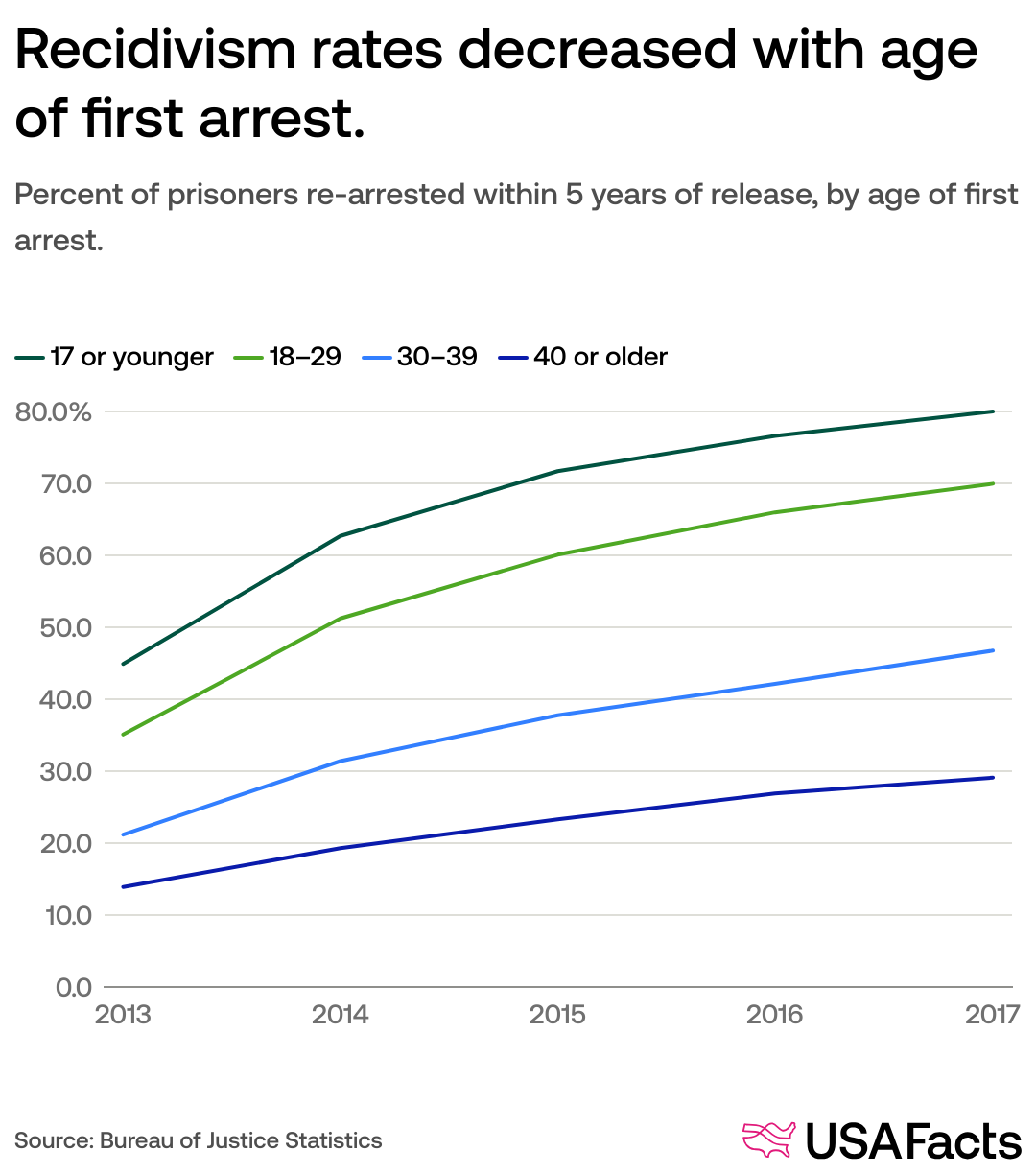
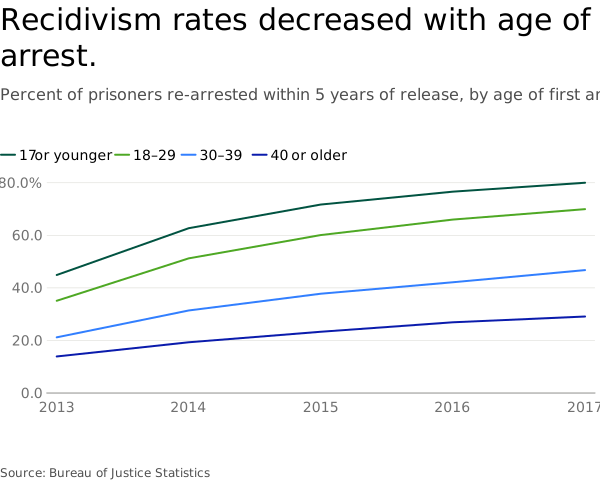
Recidivism rates are the highest for those first arrested before turning 18. The rates are lowest for those who were first arrested at 40 years or older, staying below 30%. Recidivism rates also decrease as individuals get older, regardless of the age of first arrest.
Recidivism rates decreased with age of first arrest.
Percent of prisoners re-arrested within 5 years of release, by age of first arrest.
A line chart illustrating the percent of prisoners re-arrested within 5 years of release, by age of first arrest. Recidivism rates decreased with age of first arrest.
17
or younger
18–29
30–39
40
or olderJan2013AprJulOctJan2014AprJulOctJan2015AprJulOctJan2016AprJulOctJan20170.010.020.030.040.050.060.070.080.0%
Source: Bureau of Justice StatisticsGet the dataEmbed Download imageDownload SVG
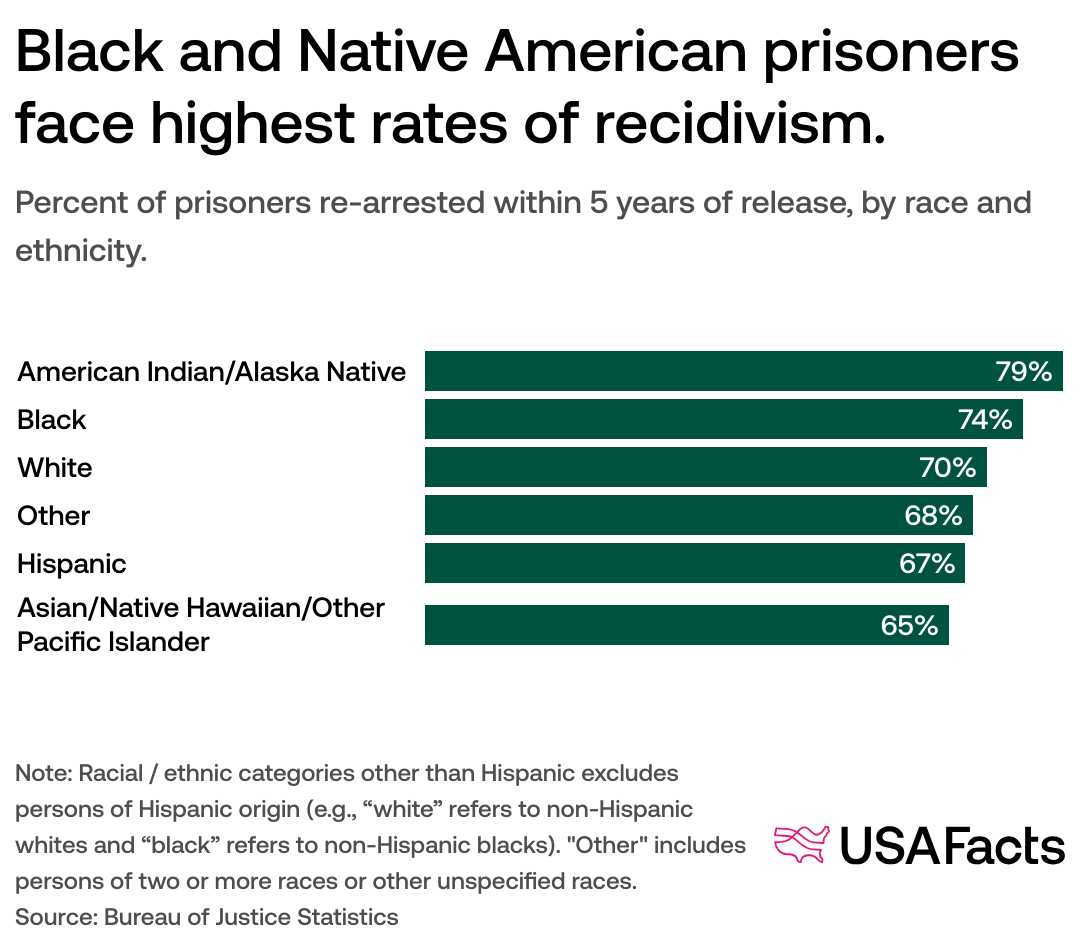
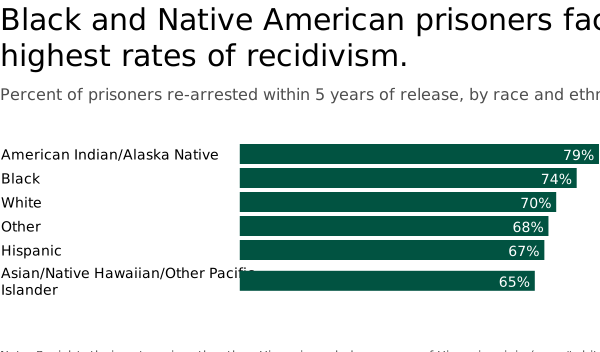
Recidivism rates are high across all race and ethnicity groups. As of 2017, American Indians and Alaska Natives face the highest levels of recidivism at 79% but are 1% of the total prison population. Black prisoners have the second-highest recidivism rate, at 74% over five years, and are about 40% of total prisoners.
Black and Native American prisoners face highest rates of recidivism.
Percent of prisoners re-arrested within 5 years of release, by race and ethnicity.
A bar chart illustrating the percent of prisoners re-arrested within 5 years of release, by race and ethnicity. Black and Native American prisoners face highest rates of recidivism.
American Indian/Alaska Native
79%
Black
74%
White
70%
Other
68%
Hispanic
67%
Asian/Native Hawaiian/Other Pacific Islander
65%
Note: Racial / ethnic categories other than Hispanic excludes persons of Hispanic origin (e.g., “white” refers to non-Hispanic whites and “black” refers to non-Hispanic blacks). “Other” includes persons of two or more races or other unspecified races.
Source: Bureau of Justice StatisticsGet the dataEmbed Download imageDownload SVG
Recidivism rates are higher for men, who are almost 95% of the prison population. The recidivism rate for women after five years was 63%, below the average for all prisoners.
Subscribe to get unbiased, data-driven insights sent to your inbox weekly
How does recidivism differ by the types of crime committed?
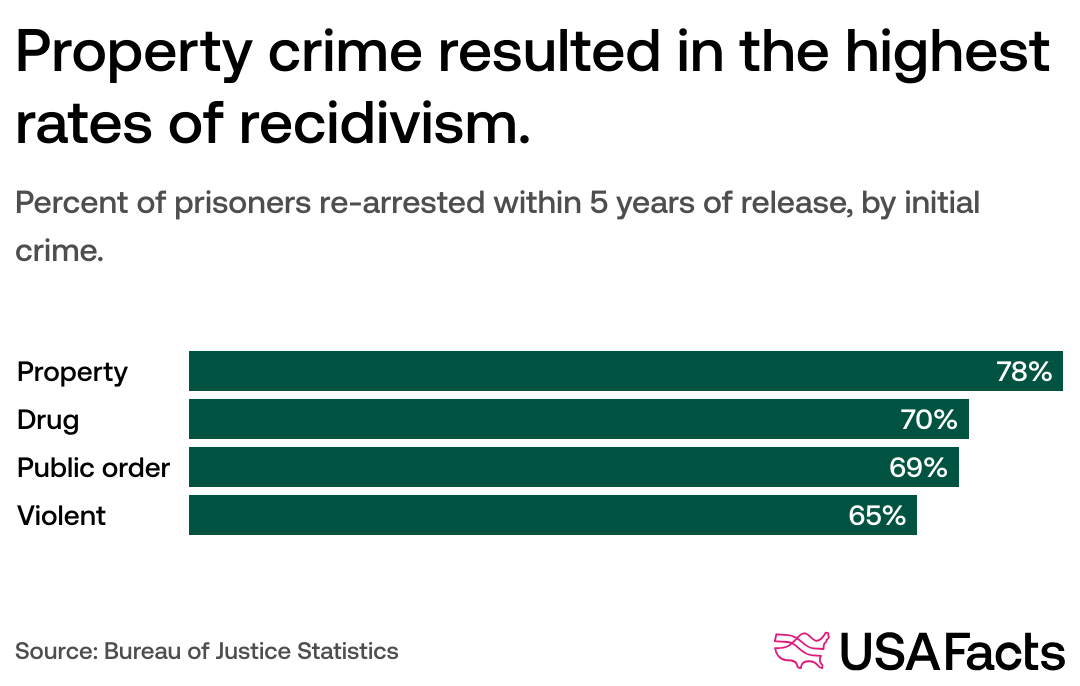
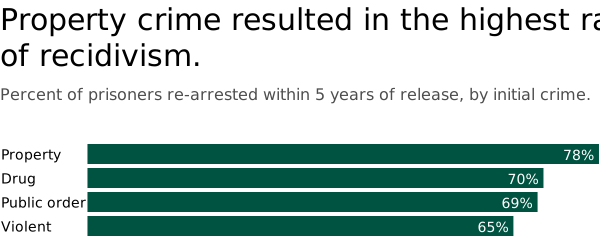
Prisoners who committed property crimes had the highest rates of recidivism, with 78% of prisoners arrested again after five years. Violent crime had the lowest recidivism rate, but prisoners also faced longer sentences than other types of crime. With longer sentences, prisoners are more likely to be older when released, which is associated with lower recidivism rates.
Property crime resulted in the highest rates of recidivism.
Percent of prisoners re-arrested within 5 years of release, by initial crime.
A bar chart illustrating the percent of prisoners re-arrested within 5 years of release, by initial crime. Property crime resulted in the highest rates of recidivism (78%).
Property
78%
Drug
70%
Public order
69%
Violent
65%
Source: Bureau of Justice StatisticsGet the dataEmbed Download imageDownload SVG
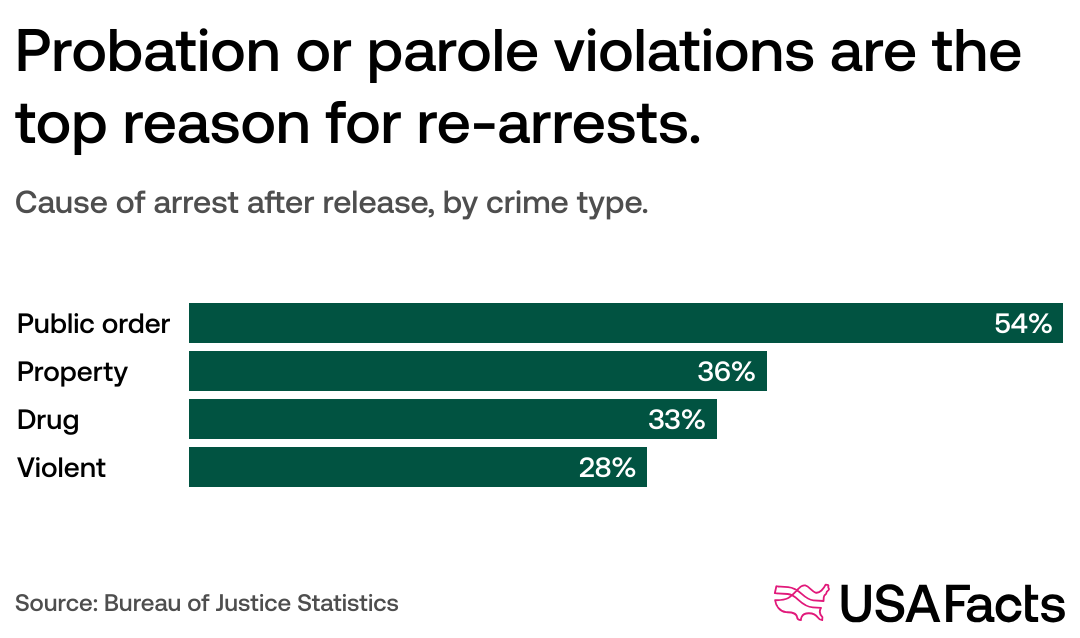
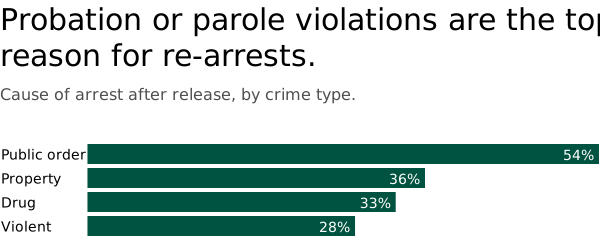
More than half of released prisoners who re-offend are arrested for public order crimes. These include probation or parole violations, DUIs, possession of weapons, and other miscellaneous violations. These arrests also resulted in the fewest returns to prison, more often resulting in fines or jail time.
Probation or parole violations are the top reason for re-arrests.
Cause of arrest after release, by crime type.
A bar chart illustrating cause of arrest after release, by crime type. Probation or parole violations are the top reason for re-arrests.
Public order
54%
Property
36%
Drug
33%
Violent
28%
Source: Bureau of Justice StatisticsGet the dataEmbed Download imageDownload SVG
A person arrested for a public order crime is often charged with other offenses at the same time. This is especially true for probation or parole violations, which are often triggered by committing a different crime.
The other three most common crimes for released prisoners are assault, theft, and drug possession. Combined, these offenses are about two-thirds of all recidivism arrests.
How are recidivism rates changing over time?
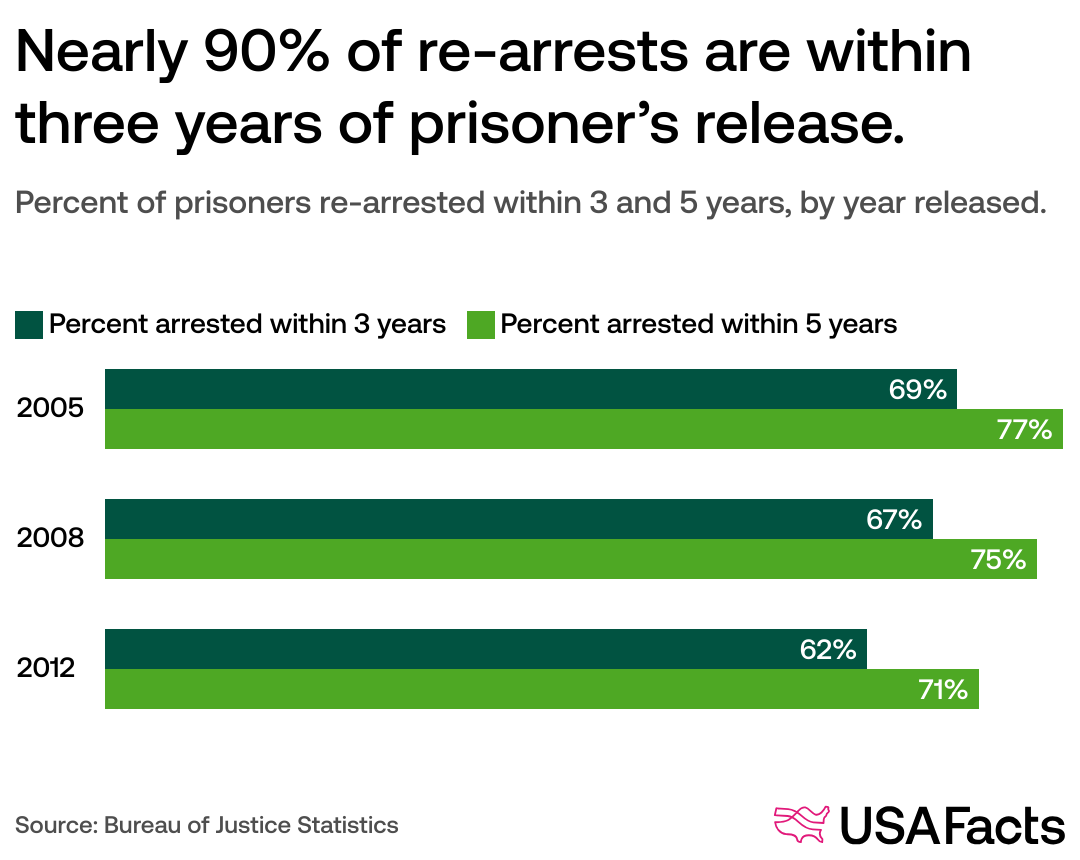
Recidivism rates fell 7% since 2005, when BJS began collecting data. But while the recidivism rate declined, some factors remain consistent. Re-arrest rates are still highest in the first year after release and almost 90% of re-arrests are within three years of prisoner’s release.
Nearly 90% of re-arrests are within three years of prisoner’s release.
Percent of prisoners re-arrested within 3 and 5 years, by year released.
A bar chart illustrating the percent of prisoners re-arrested within 3 and 5 years, by year released from 2005, 2008 and 2012. Recidivism rates fell 7% over time.
Percent
arrested within 3 years
Percent
arrested within 5 years
2005
69%
77%
2008
67%
75%
2012
62%
71%
Source: Bureau of Justice StatisticsGet the dataEmbed Download imageDownload SVG
Find out how many people are in prison in the US and get more data every week by subscribing to our weekly newsletter.
Source is no longer maintaining data, so data is current as of July 2021.
https://youtube.com/watch?v=gMpQa8xF7v8%3Frel%3D0%26enablejsapi%3D1%26origin%3Dhttps%253A%252F%252Fusafacts.org

Keep exploring
- How many states use private prisons?Feb 6, 2025
- Border recidivism: How common are repeat illegal border crossings?Aug 1, 2024
- Has COVID-19 disproportionately affected Black and Hispanic Americans?Mar 1, 2021
- How many people are in prisons in the US?Updates annually
Page sources
- Bureau of Justice StatisticsRecidivism and Reentry
- Census BureauLong-Term Economic Impact on People with Felony Convictions


See all
USAFacts is a not-for-profit, nonpartisan civic initiative making government data easy for all.
Subscribe
Subscribe to get more unbiased, data-driven insights sent to your inbox weekly.
Browse
- Crime
- Defense & security
- Economy
- Education
- Environment
- Government spending
- Immigration
- Health
- Population
More
USAFacts Instagram pageUSAFacts Facebook pageUSAFacts Twitter pageUSAFacts LinkedIn pageUSAFacts Threads pageUSAFacts TikTok pageUSAFacts YouTube channelUSAFacts Reddit page
© 2025 USAFacts. All rights reserved.Terms of servicePrivacy policyConsent PreferencesEconomy
More
AboutSubscribe
How common is it for released prisoners to re-offend?
More than eight out of every 10 youth offenders are arrested again within five years of release.
Updated May 14, 2023by the USAFacts team
Seventy percent of prisoners released in 2012 were arrested again within five years, according to data from the Bureau of Justice Statistics (BJS). The recidivism rate is over 80% for prisoners with juvenile records.
BJS defines recidivism as a re-offense by those previously in the criminal justice system. The bureau breaks down offenses into three categories: arrest, guilty conviction, and return to prison. BJS started collecting data on recidivism in 2005, tracking prisoner records over a five-year time period. The most recent data available is from 2017. The data includes prisoner records released by 34 states, representing 80% of the state prison population nationwide. The data excludes federal prisons. It also excludes state or county jails, where people are awaiting trial or sentencing, or serving less than one year of incarceration.
Former prisoners face many challenges after being released, including finding employment, housing, or receiving healthcare. A BJS study found that one-third of federal prisoners released in 2010 did not find employment within four years. Additionally, a Census Bureau study found former prisoners who were employed earned $10,000 less per year than their peers with similar educational backgrounds.
How do recidivism rates differ between demographic groups?
Recidivism rates are the highest for those first arrested before turning 18. The rates are lowest for those who were first arrested at 40 years or older, staying below 30%. Recidivism rates also decrease as individuals get older, regardless of the age of first arrest.
Recidivism rates decreased with age of first arrest.
Percent of prisoners re-arrested within 5 years of release, by age of first arrest.
A line chart illustrating the percent of prisoners re-arrested within 5 years of release, by age of first arrest. Recidivism rates decreased with age of first arrest.
17
or younger
18–29
30–39
40
or olderJan2013AprJulOctJan2014AprJulOctJan2015AprJulOctJan2016AprJulOctJan20170.010.020.030.040.050.060.070.080.0%
Source: Bureau of Justice StatisticsGet the dataEmbed Download imageDownload SVG
Recidivism rates are high across all race and ethnicity groups. As of 2017, American Indians and Alaska Natives face the highest levels of recidivism at 79% but are 1% of the total prison population. Black prisoners have the second-highest recidivism rate, at 74% over five years, and are about 40% of total prisoners.
Black and Native American prisoners face highest rates of recidivism.
Percent of prisoners re-arrested within 5 years of release, by race and ethnicity.
A bar chart illustrating the percent of prisoners re-arrested within 5 years of release, by race and ethnicity. Black and Native American prisoners face highest rates of recidivism.
American Indian/Alaska Native
79%
Black
74%
White
70%
Other
68%
Hispanic
67%
Asian/Native Hawaiian/Other Pacific Islander
65%
Note: Racial / ethnic categories other than Hispanic excludes persons of Hispanic origin (e.g., “white” refers to non-Hispanic whites and “black” refers to non-Hispanic blacks). “Other” includes persons of two or more races or other unspecified races.
Source: Bureau of Justice StatisticsGet the dataEmbed Download imageDownload SVG
Recidivism rates are higher for men, who are almost 95% of the prison population. The recidivism rate for women after five years was 63%, below the average for all prisoners.
Subscribe to get unbiased, data-driven insights sent to your inbox weekly
How does recidivism differ by the types of crime committed?
Prisoners who committed property crimes had the highest rates of recidivism, with 78% of prisoners arrested again after five years. Violent crime had the lowest recidivism rate, but prisoners also faced longer sentences than other types of crime. With longer sentences, prisoners are more likely to be older when released, which is associated with lower recidivism rates.
Property crime resulted in the highest rates of recidivism.
Percent of prisoners re-arrested within 5 years of release, by initial crime.
A bar chart illustrating the percent of prisoners re-arrested within 5 years of release, by initial crime. Property crime resulted in the highest rates of recidivism (78%).
Property
78%
Drug
70%
Public order
69%
Violent
65%
Source: Bureau of Justice StatisticsGet the dataEmbed Download imageDownload SVG
More than half of released prisoners who re-offend are arrested for public order crimes. These include probation or parole violations, DUIs, possession of weapons, and other miscellaneous violations. These arrests also resulted in the fewest returns to prison, more often resulting in fines or jail time.
Probation or parole violations are the top reason for re-arrests.
Cause of arrest after release, by crime type.
A bar chart illustrating cause of arrest after release, by crime type. Probation or parole violations are the top reason for re-arrests.
Public order
54%
Property
36%
Drug
33%
Violent
28%
Source: Bureau of Justice StatisticsGet the dataEmbed Download imageDownload SVG
A person arrested for a public order crime is often charged with other offenses at the same time. This is especially true for probation or parole violations, which are often triggered by committing a different crime.
The other three most common crimes for released prisoners are assault, theft, and drug possession. Combined, these offenses are about two-thirds of all recidivism arrests.
How are recidivism rates changing over time?
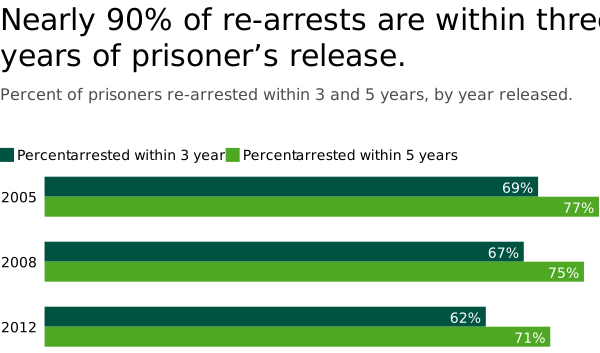
Recidivism rates fell 7% since 2005, when BJS began collecting data. But while the recidivism rate declined, some factors remain consistent. Re-arrest rates are still highest in the first year after release and almost 90% of re-arrests are within three years of prisoner’s release.
Nearly 90% of re-arrests are within three years of prisoner’s release.
Percent of prisoners re-arrested within 3 and 5 years, by year released.
A bar chart illustrating the percent of prisoners re-arrested within 3 and 5 years, by year released from 2005, 2008 and 2012. Recidivism rates fell 7% over time.
Percent
arrested within 3 years
Percent
arrested within 5 years
2005
69%
77%
2008
67%
75%
2012
62%
71%
Source: Bureau of Justice StatisticsGet the dataEmbed Download imageDownload SVG
Find out how many people are in prison in the US and get more data every week by subscribing to our weekly newsletter.
Source is no longer maintaining data, so data is current as of July 2021.
https://youtube.com/watch?v=gMpQa8xF7v8%3Frel%3D0%26enablejsapi%3D1%26origin%3Dhttps%253A%252F%252Fusafacts.org
Keep exploring
- How many states use private prisons?Feb 6, 2025
- Border recidivism: How common are repeat illegal border crossings?Aug 1, 2024
- Has COVID-19 disproportionately affected Black and Hispanic Americans?Mar 1, 2021
- How many people are in prisons in the US?Updates annually
Page sources
- Bureau of Justice StatisticsRecidivism and Reentry
- Census BureauLong-Term Economic Impact on People with Felony Convictions
See all
USAFacts is a not-for-profit, nonpartisan civic initiative making government data easy for all.
Subscribe
Subscribe to get more unbiased, data-driven insights sent to your inbox weekly.
Browse
- Crime
- Defense & security
- Economy
- Education
- Environment
- Government spending
- Immigration
- Health
- Population
More
USAFacts Instagram pageUSAFacts Facebook pageUSAFacts Twitter pageUSAFacts LinkedIn pageUSAFacts Threads pageUSAFacts TikTok pageUSAFacts YouTube channelUSAFacts Reddit page
© 2025 USAFacts. All rights reserved.Terms of servicePrivacy policyConsent Preferences