
THERE IS A SHIFT TO SUPPORTING RESTRICTIVE LAWS AGAINST TRANSGENDERISM
Numbers, Facts and Trends Shaping Your World
Read our research on:
- Research Topics
- Publications
- Our Methods
- Short Reads
- Tools & Datasets
- Experts
- About Us
>
>
- Short Reads
|
February 26, 2025
Americans have grown more supportive of restrictions for trans people in recent years
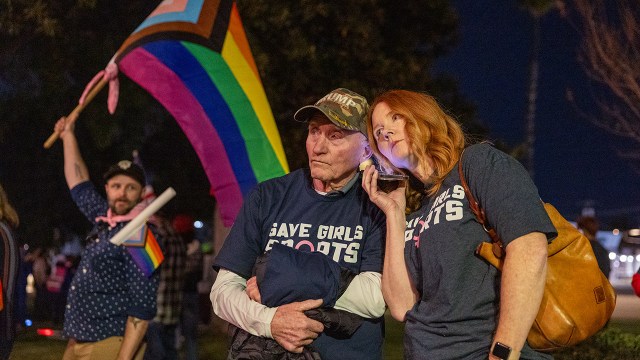
Since taking office, President Donald Trump has signed several executive orders related to transgender people. These have included orders banning trans women and girls from women’s sports and ending federal funding for health care related to gender transitions for youth.
A new Pew Research Center survey finds that majorities of U.S. adults favor or strongly favor laws and policies that:
- Require trans athletes to compete on teams that match their sex assigned at birth (66%)
- Ban health care professionals from providing care related to gender transitions for minors (56%)
How we did this
Pew Research Center conducted this analysis to explore how Americans view certain laws and policies related to transgender issues and how these opinions have changed in recent years.
For this analysis, we surveyed 5,097 adults from Feb. 10 to 17, 2025. Everyone who took part is a member of the Center’s American Trends Panel (ATP), a group of people recruited through national, random sampling of residential addresses who have agreed to take surveys regularly. The survey was conducted either online or by telephone with a live interviewer. The survey is weighted to be representative of the U.S. adult population by gender, race, ethnicity, partisan affiliation, education and other factors. Read more about the ATP’s methodology.
Here are the questions used for this analysis, the topline and the survey methodology.
At the same time, 56% of adults express support for policies aimed at protecting trans people from discrimination in jobs, housing and public spaces.
Views on these policies and several others have shifted in recent years, with Americans becoming more supportive of restrictions for transgender people, according to the survey of 5,097 U.S. adults conducted Feb. 10-17, 2025.
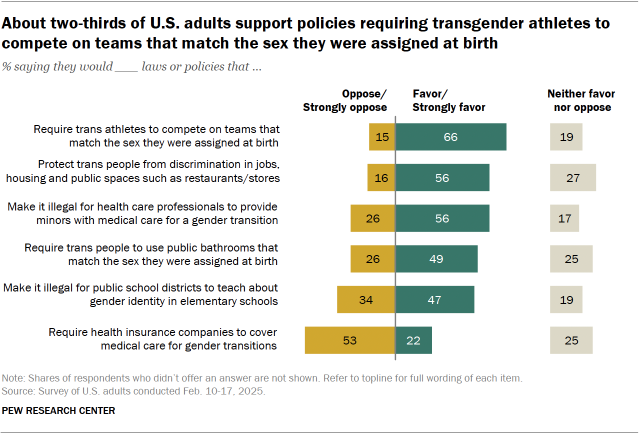
The survey also finds that more Americans support than oppose laws and policies that:
- Require trans people to use public bathrooms that match their sex at birth, rather than the gender they identify with (49% favor or strongly favor, 26% oppose or strongly oppose)
- Make it illegal for public school districts to teach about gender identity in elementary schools (47% favor or strongly favor, 34% oppose or strongly oppose)
In turn, adults are much more likely to oppose than favor policies requiring health insurance companies to cover medical care for gender transitions (53% vs. 22%).
How Americans’ views of transgender issues have changed in recent years
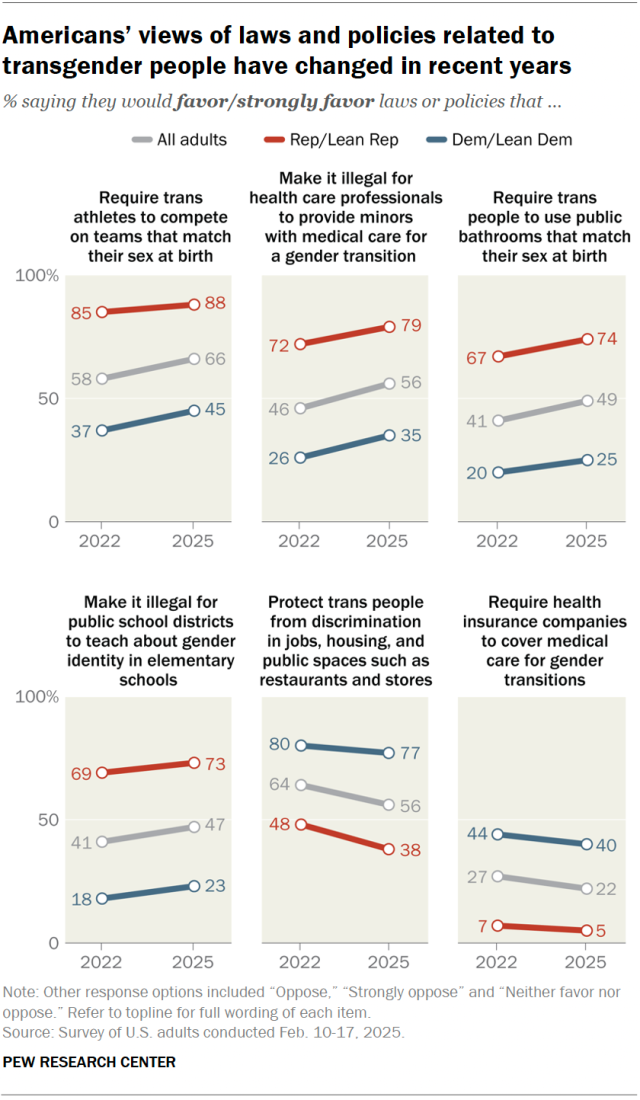
Compared with 2022, Americans have become more supportive of laws that limit protections for trans people – and less supportive of laws aimed at safeguarding them.
More Americans now say they favor or strongly favor laws and policies that:
- Ban health care professionals from providing care related to gender transitions for minors (up 10 percentage points)
- Require trans athletes to compete on teams that match their sex at birth (up 8 points)
- Require trans people to use public bathrooms that match their sex at birth (up 8 points)
- Make it illegal for public school districts to teach about gender identity in elementary schools (up 6 points)
At the same time, fewer Americans now express support for laws and policies that:
- Protect trans people from discrimination (down 8 points since 2022)
- Require health insurance companies to cover medical care for gender transitions (down 5 points)
These shifts reflect changing views among both Republicans and Democrats. For example, 79% of Republicans now support making it illegal for health care professionals to provide medical care for a gender transition for minors. This compares with 72% in 2022. On the same question, 35% of Democrats now express support, up from 26% in 2022. (These figures include independents who identify with or lean toward each party.)
As was the case in 2022, there are wide partisan gaps in views of trans issues. Republicans are much more likely than Democrats to express support for policies that limit protections for trans people (by margins of 43 to 50 points). In turn, Democrats are much more likely than Republicans to support policies that safeguard trans people (by margins of more than 30 points).
Note: Here are the questions used for this analysis, the topline and the survey methodology.
Topics
- Gender & LGBTQ
- Gender & Politics
- Gender Identity
- Health Policy
- LGBTQ Acceptance
- LGBTQ Attitudes & Experiences
Related
short readsFeb 26, 2025
Most LGBTQ adults expect Trump’s policies to affect gay, lesbian, bisexual and trans people negatively
short readsJan 24, 2025
U.S. teens are less likely than adults to know a trans person, more likely to know someone who’s nonbinary
reportJan 16, 2025
Men, Women and Social Connections
short readsFeb 27, 2024
For Women’s History Month, a look at gender gains – and gaps – in the U.S.
reportFeb 16, 2023
Black Americans Firmly Support Gender Equality but Are Split on Transgender and Nonbinary Issues
Topics
- Gender & LGBTQ
- Gender & Politics
- Gender Identity
- Health Policy
- LGBTQ Acceptance
- LGBTQ Attitudes & Experiences
Most Popular
112th grade girls are less likely than boys to say they want to get married someday
2If the U.S. had 100 people: Charting Americans’ religious affiliations
3Majorities of LGBTQ and non-LGBTQ U.S. adults under 50 want to get married someday
4What we know about energy use at U.S. data centers amid the AI boom
5Dual income, no kids: What we know about ‘DINKs’ in the U.S.
901 E St. NW, Suite 300
Washington, DC 20004
USA
(+1) 202-419-4300 | Main
(+1) 202-857-8562 | Fax
(+1) 202-419-4372 | Media Inquiries
Research Topics
Follow Us
ABOUT PEW RESEARCH CENTER Pew Research Center is a nonpartisan, nonadvocacy fact tank that informs the public about the issues, attitudes and trends shaping the world. It does not take policy positions. The Center conducts public opinion polling, demographic research, computational social science research and other data-driven research. Pew Research Center is a subsidiary of The Pew Charitable Trusts, its primary funder.
© 2025 Pew Research Center
Privacy Notice
We use cookies and other technologies to help improve your experience; some are necssary for the site to work, and some are optional. Lean more in our privacy policy.Accept All CookiesAccept only necessary cookiesCookie Settings