
GENES AND THE ENVIRONMENT

Supplementary navigation
Search
Main navigation
Menu
You are here:
- Home
- News
- Genetics, childhood aspirations and family background work together to shape status, career and health
23 December 2024
Genetics, childhood aspirations and family background work together to shape status, career and health
A study of occupational status published in Nature Human Behaviour identifies 106 genetic variants, the importance of the interplay of genetics and family environment, childhood educational and occupational aspirations, and differences across the life course and links to health.
Tags:
- Infectious and tropical diseases
- Global health and health policy
- Medical Sciences
- Policy
- Research
- Social Sciences
- Human society and culture

The landmark study authored by researchers and affiliate members at the Leverhulme Centre for Demographic Science at the University of Oxford, reveals the genetics of occupational status and their interaction with the family environment and childhood aspirations, to better understand the complex interplay between genes and environments.
While there is a wide array of studies linking genetic variants to socioeconomic indicators such as education, income, and wealth, there has been a lack of research examining occupational status – one of the most prominent measures of socioeconomic status.
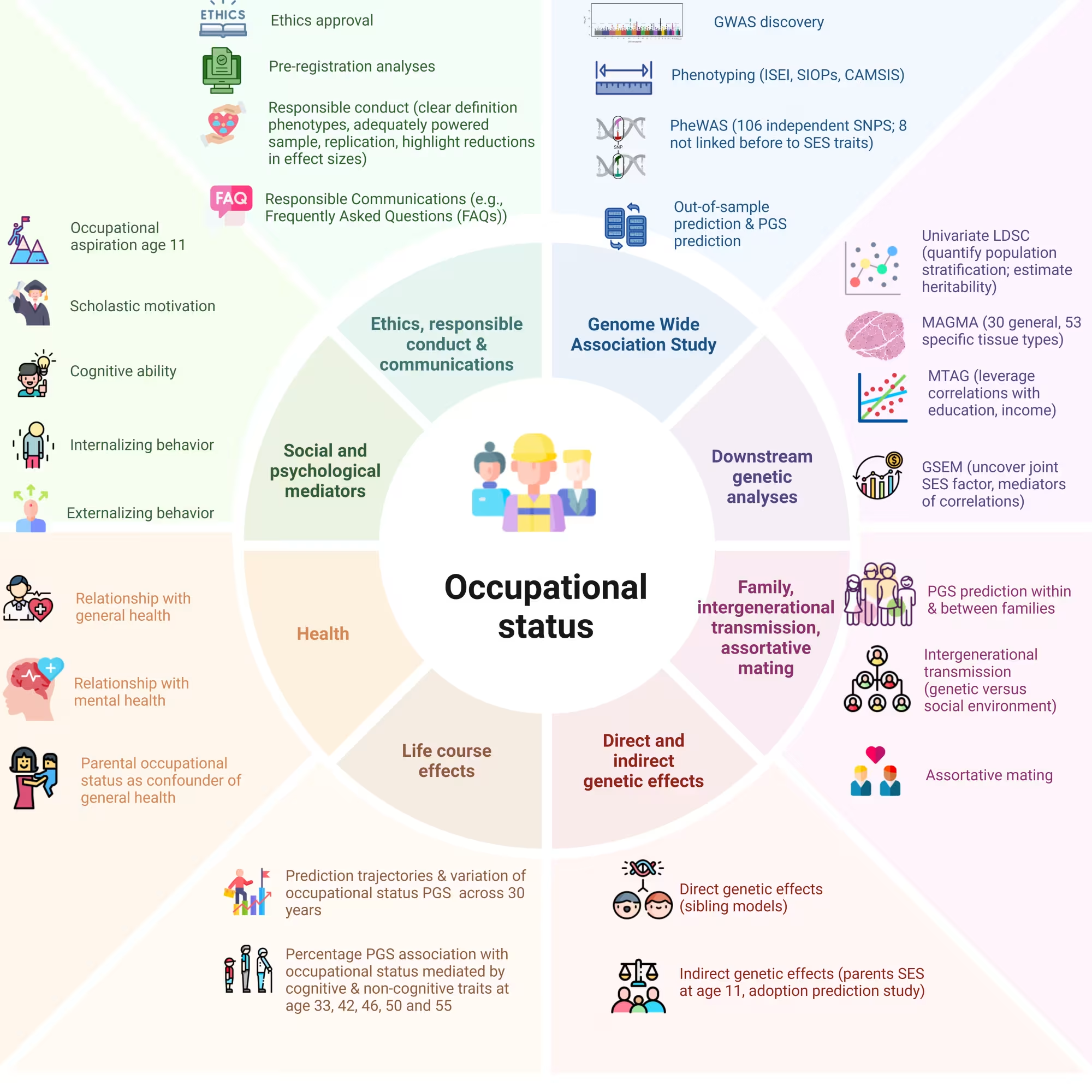
Using data from 273,157 individuals in the UK Biobank and the National Child Development Study, the researchers performed a Genome Wide Association Study on three distinct measures of occupational status – the International Socioeconomic Index (ISEI), Standard International Occupational Prestige Scale (SIOPS), and Cambridge Social Interaction and Stratification Scale (CAMSIS) – along with various follow-up statistical analyses.
The analyses identified 106 independent genetic variants of occupational status, including eight newly associated with the genetics of socioeconomic status. 5-10% of the variability in occupational status in the population can be explained through the polygenic score produced from the genome-wide association study (GWAS). The study also showed that polygenic score is picking up non-genetic family and environmental information, given that the predictive power of the score drops by over 50% when shared family environment experience of siblings is accounted for. Results showed that this reduction was largely related to socioeconomic differences in assortative mating over generations and indirect (non-genetic) parental effects.
Joint first author Dr Evelina Akimova, Assistant Professor of Sociology at Purdue University and former Postdoctoral Researcher in the European Research Council’s CHRONO project at the Leverhulme Centre for Demographic Science said, ‘This study offers the first detailed and largest genetic discovery for occupational status to date, building on decades of sociological research in this area, and highlights the important role of social and biological factors to unravel the role of genetic variants in shaping occupational status.’
As well as underscoring the genetic interdependence of the three distinct measures of occupational status, the study reveals a robust genetic correlation between educational attainment, income, and occupational status, identifying a common genetic factor of socioeconomic status.
A novel finding of the study is that the authors were able to show that the intergenerational correlation of occupational status of parents and their children is only partially explained by genetics (~38%), with 62% due to non-genetic factors such as family environment. The study also examined the polygenic scores over 30 years of employment in addition to examining the importance of childhood factors such as occupational aspiration, scholastic motivation, cognitive ability and externalising behaviour and their relationship to general and mental health.
Senior author Professor Melinda Mills, Principal Investigator of the European Research Council’s CHRONO project and Director of the Leverhulme Centre for Demographic Science and Demographic Science Unit said, ‘Our findings show the power of interdisciplinary research to uncover the complex interplay of genetic, family environment and childhood aspirations on later life course outcomes. Great care was also taken to consider the ethical dimensions of this study in addition to a detailed ‘Frequently Asked Questions’ that clarifies what the study does – and does not – find.’
This study was part of Professor Melinda Mills’ European Research Council Advanced Grant CHRONO which funded the project alongside the Leverhulme Trust, Economic and Social Research Council, United Kingdom Science and Innovation Connecting Generations Grant, MapIneq Project, and European Union’s Horizon Europe research and innovation programme.
The full article, ‘Polygenic prediction of occupational status GWAS elucidates genetic and environmental interplay in intergenerational transmission, careers and health in UK Biobank’, can be found in Nature Human Behaviour.
Related content

Fourteen Oxford academics awarded major European Research Council Advanced Grants
- Awards and funding
- Research
- Mathematical, Physical and Life Sciences
- Medical Sciences
- Social Sciences
- Humanities

OpenBind releases first open dataset and AI model for drug discovery
- Research
- Artificial Intelligence
- Medicines, treatment and drug discovery
- Mathematical, Physical and Life Sciences
- Elements, cells, molecules and atoms
- Medical Sciences
- Global health, medicine and disease

New method reveals how virus particles can build themselves, molecule by molecule
- Research
- Elements, cells, molecules and atoms
- Global health, medicine and disease
- Mathematical, Physical and Life Sciences
- Medicines, treatment and drug discovery
- Nature, climate and the physical universe
- Medical Sciences

Exceptional early-career researchers awarded 2026 European Research Council Starting Grants
- Awards and funding
- Research
- Mathematical, Physical and Life Sciences
- Humanities
- Medical Sciences
Was this page helpful?
- Yes, it was
- No, it wasn’t
Information about
- Oxford University
- Strategic plan
- Oxford’s research
- Course fees and funding
- Libraries
- Museums and collections
- Open days
- Oxford glossary
- Equality policy
- Freedom of speech statement
- Statement on modern slavery
- Data protection / UK GDPR
- Sport
- Conferences at Oxford
Information for
- Prospective undergraduates
- Undergraduate applicant privacy policy
- Undergraduate outreach privacy policy
- Prospective graduate students
- Postgraduate applicant privacy policy
- Prospective Lifelong Learning students
- Prospective online/distance learning students
- Current Oxford students
- Current Oxford staff
- Visitors/Tourists
- Media
- Alumni
- Teachers
- Businesses/Partnerships
Quick links
- OxIntranet
- Any questions?
- Jobs and vacancies
- Term dates
- Map
- Access Guide
- Nexus365 email
- Giving to Oxford
- Contact us
- Legal
- Website privacy policy
- Accessibility statement
- Cookie settings
Connect with us
© 2026 University of Oxford